
1. Reconciling Time-Series Telemetry with Subsurface Depth
Surface logging units and downhole MWD/LWD tools continuously record sensor parameters (e.g., Weight on Bit, Rotary Speed, Torque, Standpipe Pressure, Rate of Penetration, and Mud Gas) chronologically as a function of Time (UTC). In contrast, geoscientists, petrophysicists, and reservoir engineers evaluate rock formations strictly as a function of Depth along the wellbore trajectory.
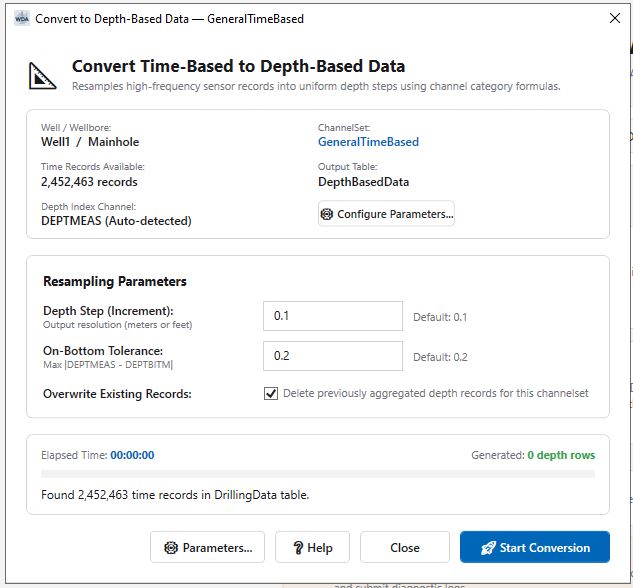
Converting chronological sensor data into geological depth logs is a complex challenge. During drilling operations, the drill string spends substantial time off-bottom—such as during pipe connections, reaming, wiper trips, and circulation intervals—where sensors continue logging while depth remains constant. The WDA Time-to-Depth Conversion Engine (accessed directly from the Databases Explorer tree by right-clicking any Channelset and selecting Convert to Depth Data...) discriminates true on-bottom cutting footage from stationary or off-bottom operations, resampling telemetry into uniform depth-indexed log tables.
2. On-Bottom Drilling Discrimination & Resampling
To prevent stationary depth smearing and eliminate artificial data clustering, the conversion engine reconciles two fundamental wellbore depth coordinates:
-
Hole Depth (
DEPTMEAS): The maximum total drilled measured depth reached by the borehole to date. -
Bit Depth (
DEPTBITM): The instantaneous positional coordinate of the drill bit cutting face along the borehole.
During active on-bottom penetration, Bit Depth progresses in lockstep with Hole Depth. WDA enforces an adjustable On-Bottom Tolerance Threshold:
Drilling Condition: | DEPTMEAS - DEPTBITM | ≤ Tolerance (default: 0.2 m / 0.5 ft)
Any sensor row where the bit is retracted off-bottom beyond the tolerance margin is automatically excluded from the depth-resampling grid. This ensures that only genuine rock-cutting parameters and newly exposed formation responses are mapped to the final petrophysical profile.
3. Mathematical Interpolation & Configuration Controls
Because physical sensor telemetry packets are logged at discrete time timestamps that rarely match exact round depth numbers, WDA applies continuous linear interpolation across bounding time samples:
-
Uniform Depth Step (Increment):
Define the target resolution of the generated depth series (typically0.1 mor0.5 ft). WDA projects continuous channels onto exact uniform depth increments, creating clean, regularly sampled logs ideal for automated petrophysical modeling and wireline overlay. -
Anti-Aliasing Linear Interpolation:
For continuous physical variables (e.g. Gamma Ray, Resistivity, Sonic Transit Time, ROP), the algorithm calculates values at target depth $D_{\text{target}}$ by interpolating between consecutive bounding time records:
Value(D_target) = V1 + ((D_target - D1) / (D2 - D1)) * (V2 - V1) -
Discrete Flag Handling:
Categorical lithology codes, bit indicators, and operational flags utilize nearest-neighbor assignment to prevent fractional mathematical distortions. -
Overwrite Management:
Easily toggle whether to replace previously converted depth records or append newly drilled intervals as operations proceed.
4. Step-by-Step Conversion Workflow
- Open the Conversion Engine: In the Databases Explorer tree, right-click any time-indexed Channelset and select Convert to Depth Data....
- Configure Parameters: Specify your target Depth Step (e.g., 0.1 m) and On-Bottom Tolerance (e.g., 0.2 m).
- Launch Resampling: Click Start Conversion. WDA's multithreaded calculation engine processes hundreds of thousands of sensor rows in the background.
- Monitor Execution: The live UI displays elapsed time, total generated depth rows inserted into the depth-indexed log table, and a progress bar.
- Inspect Converted Logs: Right-click the channelset and select Analyze Depth Data to launch the Depth Analysis Console, or export the resulting curves via the Data Export Console.
5. Related WDA Engineering Modules
- WDA: WITSML Compatible Data Analyzer: Discover WDA's columnar architecture and high-performance charting.
- Time-Based Analysis Console: Analyze raw chronological telemetry and drilling dynamics prior to depth resampling.
- Depth-Based Log Analysis & Petrophysics: Display the converted depth data in standard inverted vertical tracks with lithology and porosity shading.
By transforming uncurated time streams into clean, uniform depth logs, WDA enables drilling and subsurface teams to evaluate formations with surgical geological precision.